Blog / Creator Factory
How to Design a Creator Factory Pilot
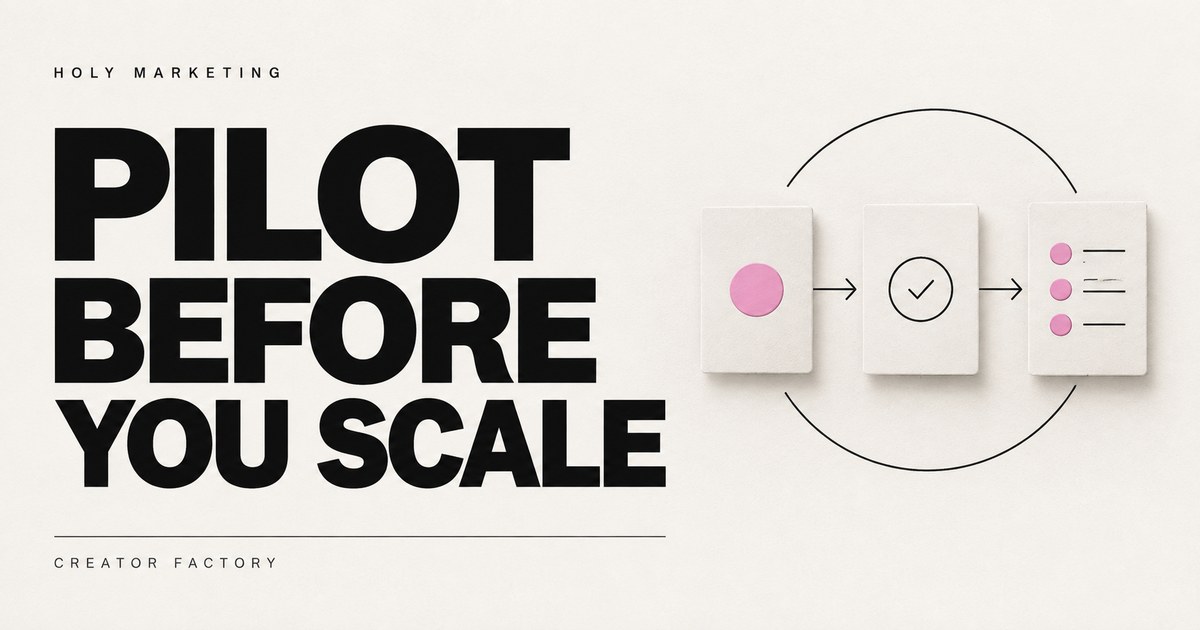
A Creator Factory pilot is a bounded test of creator-led accounts operated for a brand. Before expanding, the team needs evidence that it can publish useful content repeatedly, reach the intended audience, retain the agreed assets and access, and sustain the work at an acceptable cost.
Start with one audience, one account concept and a limited production scope. Give the pilot a decision owner, a review date and a spending limit. The output should be a documented decision about the next cycle, supported by production and audience evidence. A new account does not come with a guaranteed audience or a predictable sales date.
This guide is for brand and marketing leads evaluating Holy Marketing’s Creator Factory model. It provides an original planning worksheet. If your main decision is whether to invest in coaching or an ambassador relationship, start with our comparison of those programs.
Write the decision before the content calendar
Define the uncertainty the pilot should reduce. “Can this team operate a product-demonstration account for this customer segment with manageable review time?” is more actionable than “Can we go viral?” A useful hypothesis names the audience, recurring customer question, format, production constraint and evidence needed at review.
Illustrative hypothesis: a brand selling a product that needs explanation wants to test whether two repeatable demonstration formats can answer a particular customer’s questions. It will examine accepted content, the time needed to produce it, the audience reached and qualified actions where measurement is available. This is a planning example, not a client result.
Write down what the test will leave unresolved. A small organic pilot may inform format and operating decisions without establishing profitable acquisition, long-term retention or a causal lift in sales. Those require their own evidence.
Set a scope small enough to interpret
Choose a primary country, language, customer segment and platform before expanding the roster. Define the account’s point of view: what a viewer would return to watch, and how that connects to the product. Casting follows that concept and the work involved.
Budget coaching, product access, filming, editing, review, publishing, moderation and reporting. Identify which responsibilities sit with the brand, agency and creator. A creator’s recording fee alone does not describe the cost of operating an account.
| Scope decision | Write it down | Why it matters at review |
|---|---|---|
| Audience and account concept | Country, language, customer question and recurring point of view | Defines whose response is relevant |
| Content units | Original episodes, variations, exports and revisions counted separately | Makes production cost and output comparable |
| Distribution | Organic publishing, paid support and creator-profile promotion as separate lines | Prevents paid reach being presented as organic growth |
| Team capacity | Named owner for each approval, moderation task and report | Shows whether the operating model is sustainable |
| Limit and review | Maximum authorized spend, review date, evidence window and decision-maker | Prevents an inconclusive pilot becoming an open-ended commitment |
For example, two creators working on two formats with three episodes per format would produce 12 original episodes in a cycle. That arithmetic does not include edits, alternate hooks or extra exports. Label the count as an agreed scope, not a recommended minimum or an entitlement under any budget.
Pass an operational readiness check
Before the first public post, confirm that the brand can access the accounts and the team can perform its assigned tasks. Record the accountable account administrator, recovery owner, platform roles and handover procedure. Do not put passwords or recovery codes in a campaign worksheet.
Use supported platform roles where available. For example, YouTube channel permissions allow delegated work without sharing access to the owner’s Google Account. The available roles and limitations are platform-specific; check the actual setup rather than assuming all platforms work alike.
Also confirm the agreed content and likeness permissions, product facts, approved destination and disclosure approach. These permissions are separate from account access. For US-facing endorsements, FTC guidance explains when a material connection needs a clear disclosure. Assign a reviewer for the actual content and relevant market.
An unresolved access issue, unsupported product claim or missing required permission is a reason to pause the affected work. It is not something a promising view count can compensate for.
Run comparable production cycles
Use a first cycle to observe the whole process: briefing, filming, feedback, acceptance, publishing and reporting. Record why each asset needed a revision. Separate unclear briefs, product inaccuracies, creative choices and late stakeholder changes; they require different fixes.
In the next cycle, apply one documented learning while keeping enough of the setup stable to compare the work. If the offer, account, audience, format and paid budget all change at once, the result may still be useful operationally, but it cannot isolate the effect of one improvement.
Set a consistent observation window for audience metrics. A post measured after two days should not be ranked against another measured after two weeks without showing that difference. Review the range of post outcomes and recurring patterns alongside standout posts. An exceptional video can suggest a hypothesis without proving that the entire system is repeatable.
Maintain a small asset register: asset ID, creator, account, format, version, publish date, distribution type, cost allocation, approval reference and reporting window. It connects what was produced to what was actually published and measured.
Use a scorecard with evidence and stop conditions
Download the editable Creator Factory pilot scorecard (CSV). The worksheet leaves targets blank because acceptable cost, audience fit and output depend on the business. Agree those values before seeing the results. Record “not measurable” when evidence is missing.
| Area | Evidence to review | Decision it supports |
|---|---|---|
| Access and continuity | Verified brand access, role inventory and workable handover | Whether the operation can continue through a personnel change |
| Production reliability | Accepted assets against agreed scope; delays and causes | Whether to change capacity, ownership or workload |
| Learning quality | Specific feedback applied to a comparable subsequent assignment | Which format or creator capability to develop next |
| Audience fit | Available geography, relevant comments and content response over equal windows | Whether the account is reaching and serving the intended audience |
| Commercial evidence | Identified visits and verified downstream actions, with attribution limits | What can be said about demand and what remains untested |
| Economics | Total pilot cost, internal workload and accepted reusable output | Whether another cycle is affordable and worth funding |
For a production-cost view, divide the defined production cost by the number of accepted original assets. State which costs are included and report paid distribution separately. For the investment decision, also show the complete pilot cost, including setup, program management and internal time where recorded. A falling cost per asset is not a return-on-investment claim.
Keep funnel steps separate: a view, a site visit, a click toward a booking page and a confirmed booking are different events. If the confirmation is not connected to reporting, record that gap. See our campaign reporting guide for the evidence structure.
Make one of three explicit decisions
- Continue within the current scope: the critical operational checks pass, the evidence supports the next hypothesis and the next cycle fits the approved budget. Name the learning to pursue.
- Revise and retest: a specific, fixable constraint has been identified. Change that part, assign an owner, set a new limit and agree what would settle the question.
- Stop or pause: required access or permissions remain unresolved, the recurring work is not useful enough, or the economics exceed the agreed limit without a credible improvement plan. Document what can still be retained and used under the agreement.
Expansion is a further decision. Add an account, market or creator only when you can explain what the additional scope tests and who will operate it. Copying a successful format into a different market introduces new language, product and audience assumptions.
Our public LATAM streaming-series case illustrates a campaign organized around different account concepts. It is a specific case, not a benchmark for another brand’s pilot or proof of an expected outcome.
What should remain after the pilot?
Request an account inventory, the agreed usable content files, a versioned format playbook, an honest performance report and a recommendation for the next cycle. Identify any license, creator permission or platform limitation that constrains reuse. The value of a pilot includes the operating knowledge it leaves behind, even when the decision is to stop.
Kseniia Petrina’s SSRN paper on brand-operated creator infrastructure provides a conceptual framework for this model. It does not establish a performance forecast for your business; a pilot supplies evidence about your particular implementation.
Holy Marketing works across all countries in Latin America and the Caribbean, 15 countries in Africa, and the United States. Monthly project budgets start at US$20,000; the actual pilot scope is agreed separately. Explore Creator Factory or book a 15-minute intro call. Bring your audience, current accounts, internal capacity and the decision a pilot needs to answer.