Blog / Market entry / Localization
Localization vs. Translation in Influencer Campaigns
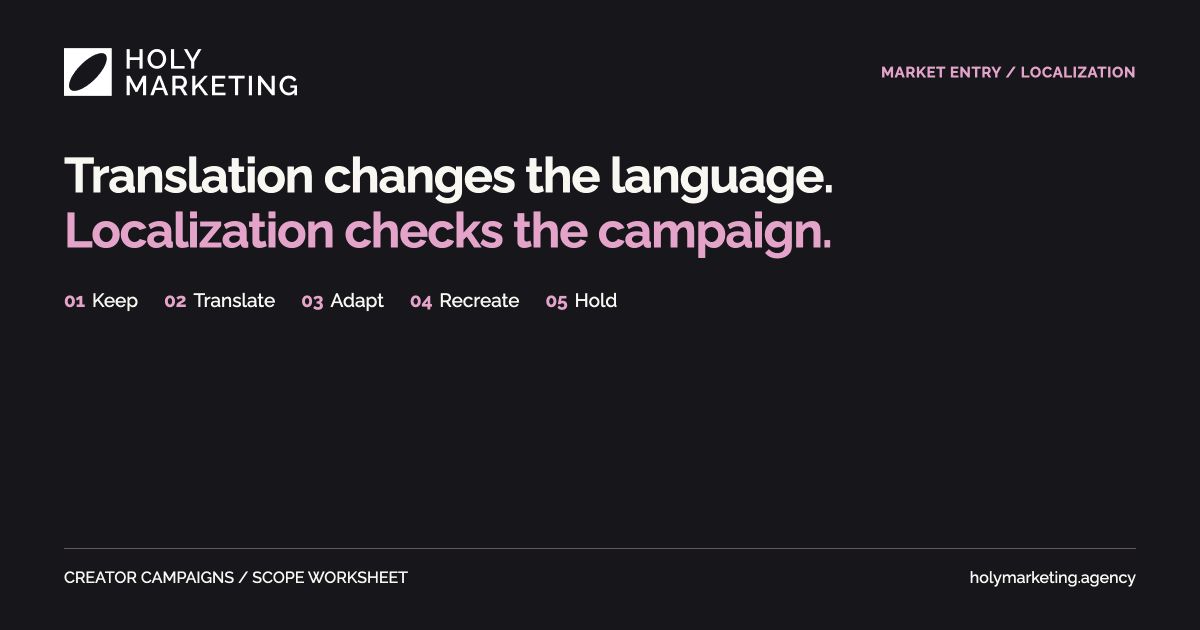
Translation changes the language of a creator's message. Localization asks whether the message, demonstration, offer, and next step work for the intended market. A brand buying a second language version should specify both jobs before approving a quote: accurate words do not establish that the underlying campaign is ready to travel.
For an influencer campaign, the useful decision is not whether localization sounds more sophisticated. It is which elements can stay, which need adaptation, and which need new evidence or production. Use the scope worksheet below to turn that decision into an assignment a creator, language reviewer, editor, and brand owner can actually accept.
What is the difference in a creator campaign?
W3C's working definition of localization includes language and other market requirements, such as formats and culturally specific references. Translation is one part of that work. A campaign can also need adaptation without changing languages: the product, retailer, delivery area, or buying occasion may differ.
| Work to commission | Question it answers | Example output | What it does not establish |
|---|---|---|---|
| Translation | Does the target-language version preserve the approved meaning? | Reviewed script, caption, and terminology | That the offer or example fits the market |
| Creative adaptation | Does the explanation make sense for this buyer and format? | Revised opening, example, sequence, or visual | That a new product claim is supported |
| Market and offer review | Can this audience act on the promise? | Confirmed product, availability, destination, and support decisions | That the campaign will generate demand |
| Production adaptation | Can the approved version be made from these materials? | Edit, new graphics, voice recording, or additional shoot | That the brand has permission for every proposed use |
These are planning categories, not universal vendor package names. Ask each supplier to describe its included outputs and review responsibilities. “Localization included” is too ambiguous to compare on its own.
Start with a change map, not a word count
Take one representative asset and mark every element that could change: the spoken explanation, on-screen text, product label, demonstration, disclosure, caption, call to action, and destination. Review it against a specific market and buyer task. “Spanish” identifies a language; it does not identify a country, service area, or product experience.
Give each element one decision:
- Keep: the brand owner has evidence that it remains accurate and relevant.
- Translate: the approved meaning stays, but the language changes.
- Adapt: the explanation or context changes while approved facts and boundaries remain intact.
- Recreate: the required product view, action, or delivery cannot be achieved with the available material.
- Hold: a required fact, permission, or operating dependency remains unresolved.
For each decision, name the evidence and owner. A creator's useful suggestion can reveal a better explanation; it should not silently become a new promise about availability, delivery, or results. Resolve that with the person responsible for the product or offer.
Download the creator campaign localization scope worksheet. It provides a blank row for each part of the customer-facing asset, with space for source and target versions, the reason for a change, review ownership, and acceptance evidence. It is a planning tool, not a claim that every campaign needs every workstream.
Decide when translation is enough
A translation assignment may be sufficient when the product, demonstrated task, offer, and intended action already fit the target audience, and the remaining work is linguistic. It still needs review in the finished format. A caption can be correct in a document yet hard to read at the pace of the edit.
Microsoft's localization guidance distinguishes language review from review in the presentation the audience will actually see. Apply that distinction to the exported video and its destination, not only to the script.
Commission broader adaptation when the buying context changes. Examples include a demonstration of a feature absent from the local product, a store reference unavailable in the market, or an opening built around an unfamiliar purchase situation. Decide whether the fix is a different explanation, a new shot, or a narrower offer. Adding subtitles cannot repair the wrong demonstration.
Give reviewers different decisions to own
A single “approved” comment can hide several unresolved questions. Assign the decisions before production:
| Reviewer | Decision to own | Evidence to return |
|---|---|---|
| Product or offer owner | Facts, availability, eligibility, and promised action are correct | Approved facts and destination reference |
| Language and market reviewer | Meaning, terminology, tone, and context fit the intended audience | Consolidated notes tied to exact lines or timecodes |
| Creator | Delivery is natural and statements reflect their actual experience | Agreed script approach and any experience limitations |
| Editor or producer | The approved changes can be implemented in the agreed format | Representative export and remaining production dependencies |
| Campaign release owner | Required reviews and permissions cover the version being released | Version reference, decisions, and outstanding holds |
One person can hold several roles when qualified and agreed. What matters is that each decision has an owner. Use our operational statement-of-work guide to connect these responsibilities to deliverables and change handling.
Keep feedback actionable. “Make it more local” is not an edit instruction. “Replace this retailer reference because the target buyer cannot use it; product owner to confirm the alternative” identifies the problem and the next decision. A preference about phrasing should not reopen an approved offer unless the reviewer identifies a factual problem.
A worked example: one video, four different decisions
Consider a fictional US home-organization brand adapting an English creator demonstration for a Spanish-language campaign in Mexico. This is a planning example, not a Holy Marketing client result or a claim about Mexican shoppers.
The source video includes a joke about a US retailer, a dimension label, a link to the US store, and a creator's personal account of using the organizer. The team's review could produce this change map:
| Element | Decision | Work to approve |
|---|---|---|
| Setup explanation | Translate | Preserve the demonstrated steps and verify the finished narration or subtitles |
| Retailer joke | Adapt | Replace it with a product-relevant opening proposed by the creator and reviewed for this audience |
| Dimension graphic | Adapt | Product owner confirms the exact variant and measurements before the editor changes the graphic |
| “Order through my link” | Hold | Commerce owner confirms a working destination and eligible offer for the intended buyer |
The existing video does not become releasable because three rows are complete. The unresolved destination still blocks that call to action. The brand can fix the destination, approve a different measurable action, or defer the placement. Each option changes the assignment; none is a translator's decision alone.
The creator's personal account also needs to remain truthful. An adaptation should not imply that the creator used a different product variant or service they did not experience. For US-facing endorsements, FTC guidance says disclosures should match the endorsement's language and warns against describing experience with products the endorser has not tried. Have the responsible reviewer check requirements for the actual markets in scope.
Compare quotes using the same acceptance scope
Ask suppliers to price the same source assets, target markets, language variants, output formats, and review rounds. Separate translation, creative rewriting, creator recording, editing, new footage, market review, and destination work where those tasks are needed. Do not compare a script-only quote with a complete finished-video assignment as if they buy the same result.
Agree what triggers a change: a new offer after script approval, another language version, a replacement product, or an additional shoot. Record which existing approvals must be revisited and who can authorize the scope adjustment. Do not invent a universal localization surcharge; the actual work and dependencies determine the estimate.
Before committing to reuse, ask the receiving editor to check the raw-footage and language-handoff requirements. Check proposed territories, edits, channels, and dates separately against the usage-rights record.
Accept the complete version, then learn from it
Review the final export, caption, disclosure, and destination together. Record the exact version, who accepted it, and what remains on hold. Recheck affected parts if the product, offer, or edit changes after approval.
For the pilot, define the learning question and available outcome data before release. A stronger result from one creator does not isolate the effect of language: audience, timing, creative, and paid support may also differ. The campaign measurement plan helps document those limits.
Planning an adaptation for a new market? Bring Holy Marketing one source asset, the target customer and market, the actual offer, and the destination. Our market-entry team can help define the research and creator work the assignment needs. If your task is a Spanish-language US campaign, start with our US planning guide.